Author: NoNarrativeLines

  • Diary #06

    Diary #06

    Millefleurs of the Healers: The Grand Pattern Inspired by My Grandmother’s “Potions”

    For (NØ), millefleurs is more than just a pattern—it’s a bloom of memories, herbs plucked by wise hands, petals transformed into remedies by a grandmother who knew the secret language of plants. This grand repeating motif, the heart of the Spell of Nature collection, is a tribute to the wildflowers she gathered like a “good white witch,” turning them into healing “potions.” Here’s how this magical millefleurs came to life, between tradition and poetry.

    Day 23 : Flowers of Memory

    It all begins with an open sketchbook, yellowed pages, scribbled notes, and the memory of my grandmother’s hands brushing through the fields. For (NØ), this motif could only be born from those flowers: daisies, yarrow, primroses, and all the herbs she called her “allies.” The first sketches are homages—ink lines retracing the gestures of the past, when she would pick, dry, and whisper Latin names like incantations.

    Inspirations for the new Millefleurs Pattern

    Day 24 : The Language of Petals

    Once the flowers are sketched, it’s time to arrange them. For (NØ), this millefleurs is not just a pattern—it’s a visual grammar, where every petal has its place, just as every plant had its purpose in my grandmother’s hands. Yarrow for soothing, poppies for sleep, foxgloves for the heart… Here, they mingle in an endless meadow, as if scattered by the wind. The challenge? Keeping that sense of organized chaos, of nature both wild and intentional.

    Empty spaces waiting to be filled by wild flowers

    Day 25 : Repetition as Ritual

    With the flowers in place, the work of repetition begins. For (NØ), this is almost a sacred act: ensuring that the motif, once repeated, evokes the abundance of meadows, the generosity of the earth. Each element must fit together like my grandmother’s recipes—precise in their disorder, effective in their gentleness. Lines overlap, colors harmonize, and little by little, the motif becomes an endless field, where every flower seems to have been picked and placed there at just the right moment.

    Millefleurs pattern filling the gaps

    Day 26 : The Healing Motif

    The final step is where the millefleurs reveals its magic. For (NØ), this grand repeating motif is more than just a design—it’s a visual potion, a remedy on paper. All of my grandmother’s flowers are there, scattered as they once were in her jars, sachets, and vials. But here, they never fade. They dance in infinite repetition, offering their beauty and their memory to whoever wears them. As she used to say: “Flowers don’t just heal the body, they soothe the soul.”

    Millefleurs pattern in full repeat

    Day 27 : A Spell in Repeat

    This millefleurs is more than a tribute—it’s a transmission. For (NØ), it carries my grandmother’s hands, her wisdom, her rituals. It’s a motif that doesn’t just decorate—it tells a story, it soothes, it reminds us that beauty and healing can grow side by side, like wildflowers by the wayside. And perhaps, in looking at it, you’ll still hear her laughter as she crushed petals in her mortar, whispering: “Look, my dear, magic is everywhere.”

    Echinacea

    Want to follow the journey?
    Sign up for (NØ)’s Letter to receive weekly studio updates, or explore the collection as it unfolds on Instagram with #NØSpellOfNature.

  • DIARY #05

    DIARY #05

    In the Margins: Five Days of Sketching Spell of Nature

    For (NØ), creativity doesn’t always demand a studio, a schedule, or even silence. Sometimes, it simply needs the margins—the stolen moments between school runs and snacks, the quiet corners of a day where ink meets paper and ideas begin to bloom. This is how the loose motifs for Spell of Nature came to life: not in grand gestures, but in the gentle rhythm of a school break, one sketch at a time.

    Day 18 : Ink in the Margins

    The sketchbook lies open, a page filled with loose ink motifs—delicate stems, half-formed petals, and the first whispers of what will become repeating patterns. These aren’t polished drawings; they’re the raw beginnings, the seeds of a collection sown in the margins of a busy day. For (NØ), this is where the journey starts: not with certainty, but with curiosity. The ink is still wet, the lines still uncertain, but the intention is clear. This is the first step—where summer’s wild beauty begins to take shape on paper.

    Inked flowers

    .

    Day 19 : Building the Motif Library

    By the second day, the sketchbook has become a library of fragments. Each motif is a potential piece of the final puzzle, a small burst of inspiration captured in ink. For (NØ), these sketches aren’t just drawings; they’re the building blocks of a narrative. Created in the quiet pockets of time while the kids play, they’re proof that creativity doesn’t need hours—just moments. The motifs are loose, unrefined, but full of possibility. This is where the collection begins to breathe, where every line is a step closer to the whole.

    Inked floral fragments

    Day 20 : Ink & Intuition

    Day three is about trust. The motifs are no longer just sketches; they’re becoming a language. For (NØ), this is where intuition takes over—where the hand moves without overthinking, and the ink flows like a conversation. There’s no pressure here, no need for perfection. Just the quiet joy of creation, the kind that fits into the spaces between life’s demands. These motifs are wild, imperfect, and alive—just like the flowers that inspired them.

    Flowers black ink

    Day 21 : The Rhythm of Repetition

    By the fourth day, the motifs start to feel familiar. They’re no longer just individual drawings; they’re beginning to repeat, to find their rhythm. For (NØ), this is where the pattern emerges—not in a single grand design, but in the repetition of small, deliberate strokes. The motifs are still loose, still in progress, but they’re starting to dance. This is the magic of the margins: where creativity doesn’t need a stage, just a moment to unfold.

    Inked leaves and branches

    Day 22 : More Ideas

    On the fifth day, the motifs are ready. Not polished, not perfect, but full of life and potential. For (NØ), these loose ends are the heart of Spell of Nature—proof that creativity doesn’t need a studio or a schedule. It just needs a sketchbook, a little ink, and the willingness to begin. These motifs, sketched in the margins of life, are now ready to become something greater: repeating patterns that will carry the wild beauty of summer into every design.

    Petals and stems inked

    The Magic of the Margins

    Spell of Nature isn’t just a collection of patterns; it’s a tribute to the quiet moments where creativity thrives. These five days of sketching in the margins remind us that inspiration doesn’t always need grand gestures. Sometimes, it just needs a pause—a moment to pick up a pencil, to let the ink flow, and to trust that the story will unfold, one line at a time.

    Want to follow the journey?

    Sign up for (NØ)’s Letter to receive weekly studio updates, or explore the collection as it unfolds on Instagram with #NØSpellOfNature.

  • Diary #04

    Diary #04

    A Tossed Wildflower Bed: The Making of a Pattern

    For (NØ), creating a tossed wildflower pattern is like capturing summer in motion—where flowers scatter as if tossed by the wind, where chaos and beauty intertwine. This is the story of how Spell of Nature’s wildflower bed came to life, one petal at a time.

    Day 14 : The First Scatter

    It always begins with a single bloom. For (NØ), the first step is to sketch the wildflowers as they might fall—loose, organic, and full of life. The page becomes a meadow, and each stroke of ink is a petal tossed by the breeze. This isn’t about precision; it’s about movement, about the way flowers grow wild and free. The first scatter is just the beginning—a promise of what’s to come.

    Herbier
    close-up of a wildflowers sketch

    Day 15 : Filling the Gaps

    Once the first flowers are in place, the empty spaces begin to call. For (NØ), these gaps aren’t voids—they’re opportunities. Smaller blooms, delicate stems, and tiny leaves start to fill the page, creating a sense of depth and rhythm. This is where the pattern starts to breathe, where the wildflowers begin to feel like a true bed of summer—lush, layered, and alive.

    Lost in The Repeat

    Day 16 : Refining the Rhythm

    With the page now full of flowers, the next step is refinement. For (NØ), this is where intuition takes over. Some blooms are adjusted, others are moved, and the balance of the pattern begins to emerge. It’s not about perfection; it’s about harmony—about ensuring that every flower feels like it belongs, as if it were plucked from a meadow and gently placed on the page.

    Checking the repeat

    Day 17 : The Final Toss

    The last step is where the magic happens. The wildflowers are now a seamless repeat—a tossed bed of blooms that feels endless, as if it could stretch on forever. For (NØ), this is the heart of Spell of Nature: a pattern that doesn’t just mimic the wild, but feels like it. It’s summer captured in ink, ready to bloom again and again.

    All Over pattern in full repeat

    The Wild in Repeat

    A tossed wildflower pattern isn’t just a design—it’s a celebration of nature’s unpredictability. For (NØ), this is where the wild finds its rhythm, where every bloom tells a story, and where the beauty of summer is preserved in repeat. It’s a reminder that sometimes, the most captivating patterns are the ones that feel the most alive.

    Want to follow the journey?

    Sign up for (NØ)’s Letter to receive weekly studio updates, or explore the collection as it unfolds on Instagram with #NØSpellOfNature.

  • Diary #03

    Diary #03

    For (NØ), the transition from hand-drawn motifs to digital prints is where the magic of Sortilège de Nature truly begins to bloom. It’s a quiet alchemy—where ink meets pixels, where the wild beauty of summer is preserved and transformed into the smallest motifs of the collection, known as the “blenders.” These delicate designs bring a sense of calm and rest for the eye, offering a moment of pause. And it’s in the silence of the studio that they take shape, one by one, with only the sound of the brush on paper and the scent of India ink slowly spreading across the page.

    Day 11 : Sketches

    The first step is always the most delicate: sheets of paper filled with hand-drawn motifs, carefully arranged and ready to be scanned. These aren’t just drawings; they’re the raw ingredients of what will become the blended prints of Sortilège de Nature. For (NØ), this moment is about trust—trusting that the hand-drawn lines will find new life in the digital world. The motifs are still tangible, still tied to the paper they were born on, but they’re on the brink of transformation.

    Sketches for a blender Print

    Day 12 : Coming To Life

    Paper and ink materials

    Inspired by summer walks, here’s an idea taking shape…A small leaf motif found along country paths.

    Day 13 : Scrolling Branches

    Pencil and ink sketches of repeating branches, perfectly aligned and ready to be scanned… The digital transformation is underway!

    Scrolling Branches
    Branches and leaves, inked

    The Alchemy of digitalizing

    The process of turning hand-drawn motifs into digital blended prints is far more than a technical step—it’s where the soul of Sortilège de Nature is preserved and amplified. It’s a reminder that creativity doesn’t end with the last stroke of ink; it evolves, adapts, and finds new ways to flourish. For (NØ), this is where the collection truly comes to life—where the wild, the handmade, and the digital come together in harmony.

    Want to follow the journey?

    Sign up for (NØ)’s Letter to receive weekly studio updates, or explore the collection as it unfolds on Instagram with #NØSpellOfNature.

  • Diary #02

    Diary #02

    The Birth of Spell of Nature: A Behind-the-Scenes Journey into the New Collection. For (NØ), every collection begins with a whisper—not of ink or paint, but of memory, of place, of the stories that linger in objects and moments. Spell of Nature is no exception. Born from a summer walk, from the quiet wisdom of a grandmother who spoke to plants as if they were old friends, and from petals pressed between the pages of a sketchbook, this collection is a tribute to the unseen magic of the wild.

    Here’s how the mood board for Spell of Nature came to life—step by step, fragment by fragment.

    Day 6: A Walk, a Breath, a Spell

    It all begins with summer walks… during which (NØ)’s grandmother shared secrets. She whispered to the plants, and they whispered back. These moments, captured in a video where golden light filters through wild grasses, became the initial spark of Spell of Nature—a collection that will carry her quiet alchemy into every motif.

    The inspiration behind Spell of Nature is more than visual—it’s emotional. It’s the memory of a summer’s day, the wisdom passed down through generations, and the belief that plants hold their own kind of magic. This walk wasn’t just a stroll—it was the beginning of a story.

    Day 7: The First Words

    Before the first line is drawn, there are the words. Scattered across a page like seeds, they hold the bones of the story: “whisper,” “spell,” “wild,” “hidden,” “alchemist.” For (NØ), this mind map is the first sketch—not of shapes, but of meaning. These words will weave through the collection, guiding each motif like a quiet incantation.

    Mindmapping in a sktechbook

    This isn’t just brainstorming; it’s storytelling. Each word is a thread that will eventually stitch the collection together, giving it depth, intention, and a sense of place. For (NØ), naming the narrative is as important as drawing it.

    Day 8: Pages of Summer

    The sketchbook doesn’t just hold sketches—it cradles memories. Between its pages, pressed flowers and leaves keep the whispers of that summer walk: the golden light, the rustle of grass, the quiet magic of wild things. These fragments are the first brushstrokes of the collection, a way to carry the soul of summer into the motifs to come.

    Moodboard and slow design

    For (NØ), these pages are more than inspiration—they’re a portable sanctuary. Wherever the journey leads, the sketchbook follows, keeping the essence of the collection close. A reminder that beauty isn’t just seen; it’s carried, preserved, and revisited.

    Day 9: The Heart of Spell of Nature

    A summer walk, pressed flowers, faded botanical prints, and the quiet wisdom of (NØ)’s grandmother, who knew the language of wild plants like a second tongue. This board isn’t just inspiration; it’s a map of memories, a guide to the stories that will unfold in the motifs.

    Every element has a role. The botanical prints connect to the past, the pressed flowers to the summer walk, and the handwritten notes to the narrative that ties it all together. For (NØ), a mood board isn’t just a tool—it’s the heart of the collection, the place where all the threads of the story come together and weave the fabric of what’s to come.

    Day 10: A Mood Board to Carry

    The mood board for Spell of Nature doesn’t live on a wall—it lives in a sketchbook. Small enough to slip into a bag, close enough to keep inspiration always within reach. For (NØ), this is where the collection begins: pressed leaves, faded botanical prints, and scribbled notes in the margins. A portable sanctuary of ideas, ready to travel wherever the path leads.

    Portable Inspiration, a moodboard in a sketchbook

    This sketchbook is more than a tool—it’s a companion. It holds the memories of the summer walk, the wisdom of (NØ)’s grandmother, and the first sparks of the collection’s narrative. Wherever (NØ) goes, the sketchbook follows, keeping the heart of Spell of Nature always close at hand.

    The Story Behind the Collection

    Spell of Nature is more than just a collection of patterns—it’s a tribute to the quiet magic of the wild, to the wisdom of those who came before, and to the stories that live in the details. From a summer walk to a sketchbook mood board, every step of the process is intentional, poetic, and deeply personal.

    This is how a collection begins—not with certainty, but with curiosity. Not with answers, but with questions. And in the quiet spaces between the pages, the first lines of Spell of Nature start to take shape.

    Want to follow the journey?

    Sign up for (NØ)’s Letter to receive weekly studio updates, or explore the collection as it unfolds on Instagram with #NØStudioDiary.

  • Diary #01

    Diary #01

    (NØ)’s Studio Diary: A behind-the-scenes look at the birth of a new collection :

    In the stillness of the studio, before the first line is drawn or ink touches paper, there is the gathering. For (NØ), every new collection begins not with a plan, but with a pause—a moment to listen, to observe, and to let the world speak. This week, the studio has become a sanctuary of fragments: vintage books, dried leaves, objects that carry their own stories. Here’s how the first seeds of inspiration are planted, one moment at a time.

    Day 1: Where It All Begins

    The working title "Spells of Nature".

    For (NØ), the creative process isn’t about rushing to the finish line. It’s about honoring the quiet moments that ignite the journey. The objects on the desk aren’t just tools; they’re storytellers, each carrying a fragment of a narrative that will eventually weave into the collection. For (NØ), every collection is a story, and it begins with a working title, a selection of words… For each new project, (NØ) starts with a kind of “naming ceremony.”

    Day 2: The Power of a Single Object

    Sometimes, all it takes is one object to set the story in motion. Today, it’s a board of dried flowers and leaves—delicate, fragile, carrying invisible journeys and memories of a summer walk. They become more than objects; they’re like characters waiting to come to life, motifs ready to unfold.

    Pressed flowers and leaves, delicate inspiration

    The beauty of inspiration lies in its simplicity. A leaf, a key, a seashell—each can hold an entire world of meaning. For (NØ), these objects aren’t just starting points; they’re the very heart of the narrative.

    Day 3: The Atlas of Stories

    The Atlas des plantes des champs, des prairies et des bois rests closed on the desk. Its weight is a promise of the stories it holds. There’s something sacred in the anticipation, in the silence before the reveal. This book, with its delicate illustrations of plants and flowers, is more than a reference—it’s a guide, a whisper from the past that will shape the motifs of the future.

    Atlas de poches des plantes des champs, des prairies et des bois, closed book on the desk, waiting to be open

    Old books like this one aren’t just sources of inspiration; they’re bridges between past and present. Each page holds a fragment of nature’s language, waiting to be translated into something new.

    Day 4: Chaekgeori and the Art of Still Life

    Inspiration also comes from the quiet beauty of chaekgeori, the Korean art of still life. Books, feathers, porcelain—each object is arranged as if it has always belonged, telling a story without words. For (NØ), this is a reminder that beauty isn’t just seen; it’s felt. The way light catches a feather, how a book’s spine tells of time, the silence between objects that somehow speaks—these are the moments that inspire.

    The traditional Korean art of stilllife : Chaekgeori, a Minhwa style.

    Still life isn’t just about arrangement; it’s about storytelling. Each object in a chaekgeori composition has a role to play, a story to tell. For (NØ), this is the essence of inspiration: finding the narrative in the quiet, the poetry in the everyday.

    Day 5: The Atlas Opens

    Today, the Atlas lies open, its illustrations like quiet invitations. The lines of a leaf, the curve of a stem—each page is a fragment of nature’s own language, ready to be transformed into motifs. There’s poetry in botanical prints: they don’t just show plants; they tell their stories. For (NØ), this is where the collection truly comes to life—not in the drawing, but in the listening.

    "L'atlas de poche des plantes des champs des prairies et des bois", open, ready to become inspirational !

    The illustrations in these old books aren’t just images; they’re narratives waiting to be reinterpreted. The way a leaf curves, the texture of a petal—these details will become the foundation of the new collection.

    The Art of Gathering Inspiration

    Gathering inspiration isn’t about collecting objects; it’s about listening to their stories. For (NØ), this process is slow, intentional, and deeply personal. It’s about letting the objects speak, giving them space to reveal their narratives. Whether it’s the delicate lines of a botanical print, the quiet elegance of a chaekgeori still life, or the simple beauty of a dried stem, each fragment carries a piece of the story that will become the collection.

    This is where the journey begins—not with certainty, but with curiosity. Not with answers, but with questions. And in this calm, intentional space, the first lines of the new collection begin to take shape.

    Want to follow the journey?

    Sign up for (NØ)’s Letter to receive weekly studio updates, or follow along on Instagram with #NØStudioDiary.

  • (IN IMMERSION)

    (IN IMMERSION)

    There are seasons when the studio feels familiar — and others when a door opens, almost in silence.
    This is one of them. At the beginning of this year, (NØ) chose to enter a new chapter of learning through the online program Immersion, created by Bonnie Christine — a course devoted to the art and architecture of surface pattern design.
    Not as a departure. 
But as an expansion.

    The Thought Behind This First Step

    For a quiet brand, growth must remain intentional. (NØ)NARRATIVE-LINES is built around slowness, texture, gesture, and sincerity. Around the conviction that beauty does not need to raise its voice to be felt. And yet — devotion to craft, to savoir-faire, also calls for structure. For clarity. For learning how to let poetic work travel further without losing its soul.

    Un secret bien gardé ?

    The decision to join Immersion emerged from this alignment: to strengthen the foundations of a sustainable creative practice, to refine artistic language, to bring scenographic depth to new surfaces — and to build something solid, anchored in the tangible.
    This is not a pivot. It is a deepening.

    A Beginning in Objects

    There is something almost ceremonial about opening a box filled with possibility.
    The parcel arrived quietly — inside, a carefully bound workbook. The texture of its cover, a generous linen, invites a return to sincerity of feeling. A small booklet of printed materials — windows opening onto inspiration. Tangible tools for shaping reflection… and an inspiration box designed to accompany the months ahead.
    Paper against paper. Ink. Structure. Pencil. Promises.

    Why This Matters

    For those who follow the work of (NØ) — collectors, boutique curators, interior designers, and above all sensitive souls — this step belongs to a wider intention: to create worlds that nourish emotionally. To bring narrative textiles and papers into our interiors. To allow softness to sustain itself.
    To learn, so that professional development does not dilute poetry but protects it. So that structure becomes scaffolding — allowing imagination to rise higher.

    Surface Immersion Workbook

    The Practice of Presence

    It takes a certain kind of courage to begin again — even after haute embroidery ateliers, opera backstage corridors, studios inhabited by thread and silence.
    To be a student is to remain porous.
To admit that gesture evolves.
To choose discipline in service of freedom.
    Sharing this journey publicly with you adds a quiet layer of commitment. No urgency. No pressure. Simply presence.
    The months ahead will be shaped by exercises, fears, doubts, and refinements. They will require consistency — a value dear to (NØ), even within a poetic life shaped by the materiality of color, the fluidity of images, and midnight ideas.

    Analog Treasures Close ups

    A Gentle Promise

    This new path does not seek to become louder.
It seeks to become clearer.
    Clearer in vision.
Clearer in offering.
Clearer in the bridge between art and those who long to live with it.
    For the dreamers in search of sincerity within their spaces.

    Analog treasures, take it in your hands, feel the real thing. Then, start thinking !

    The door has opened.
    And the work — patient, textured, intentional — continues.
    A gentle act of commitment to oneself. A way of saying: this path is real, and it begins here — in the vulnerability of new beginnings, in doubt, unsteady, fragile, impatient… and with you.

  • ( SINGULAR SUPPLIES )

    ( SINGULAR SUPPLIES )

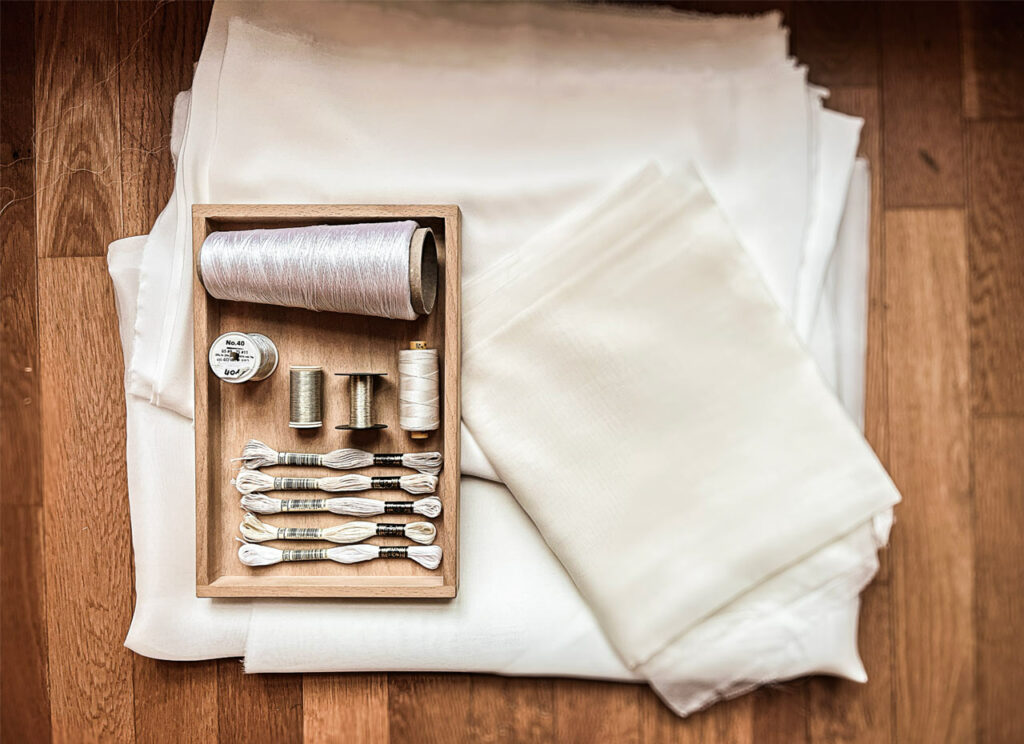
    Before the dress exists, there is a table. A surface covered in pale tones. Small containers. Folded lengths. Coiled threads. Nothing is assembled yet. Everything is already speaking. In the studio of (NØ), preparations for a singular dress unfold in silence — the kind that belongs to ateliers, where materials are not chosen quickly, but listened to. White does not arrive alone. It brings its variations. Cream, ivory, champagne.
    Light white gold, silver — barely luminous, never insistent. Each shade carries a different temperature, a different memory of light. Together, they compose a family rather than a contrast. No opposition. No hierarchy. Only nuance. This is the palette chosen for a wedding dress meant to linger — not to perform.

    Fabrics — the quiet architecture

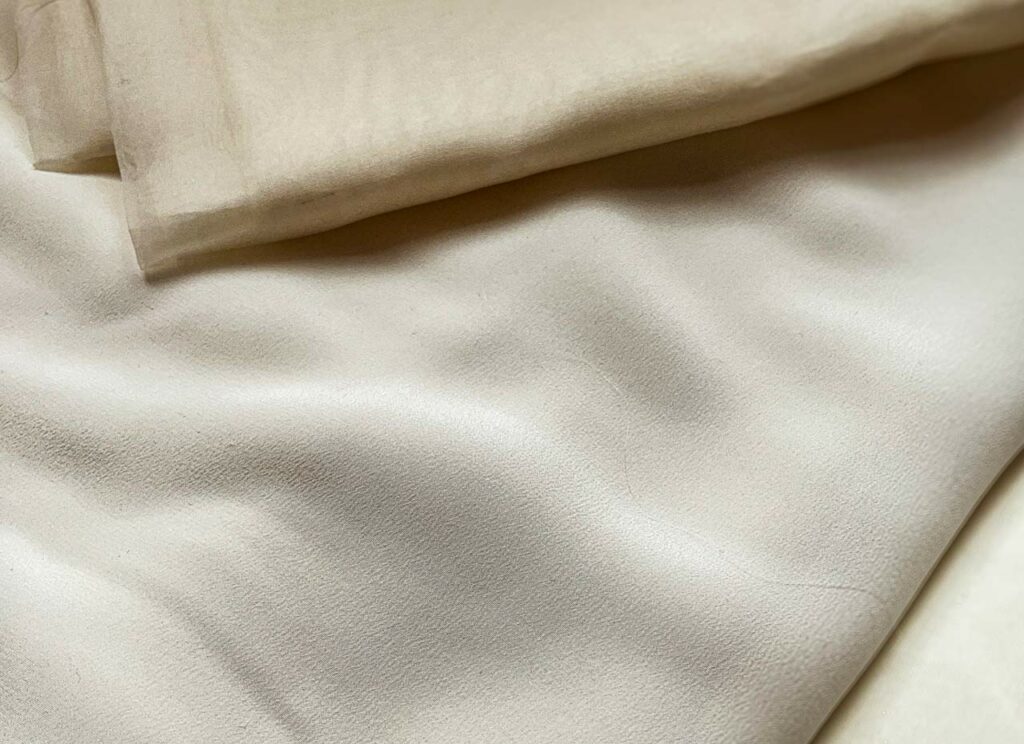
    Fabrics are laid out like grounds for future gestures.

    Silks that accept embroidery without resistance. Satins that reflect softly, never sharply.
    Organza that hold air as much as thread. These materials are not decorative by nature. They are receptive. They allow what will come later — stitches, beads, motifs — to exist without strain. In haute couture embroidery, the fabric is not a background. It is a collaborator.
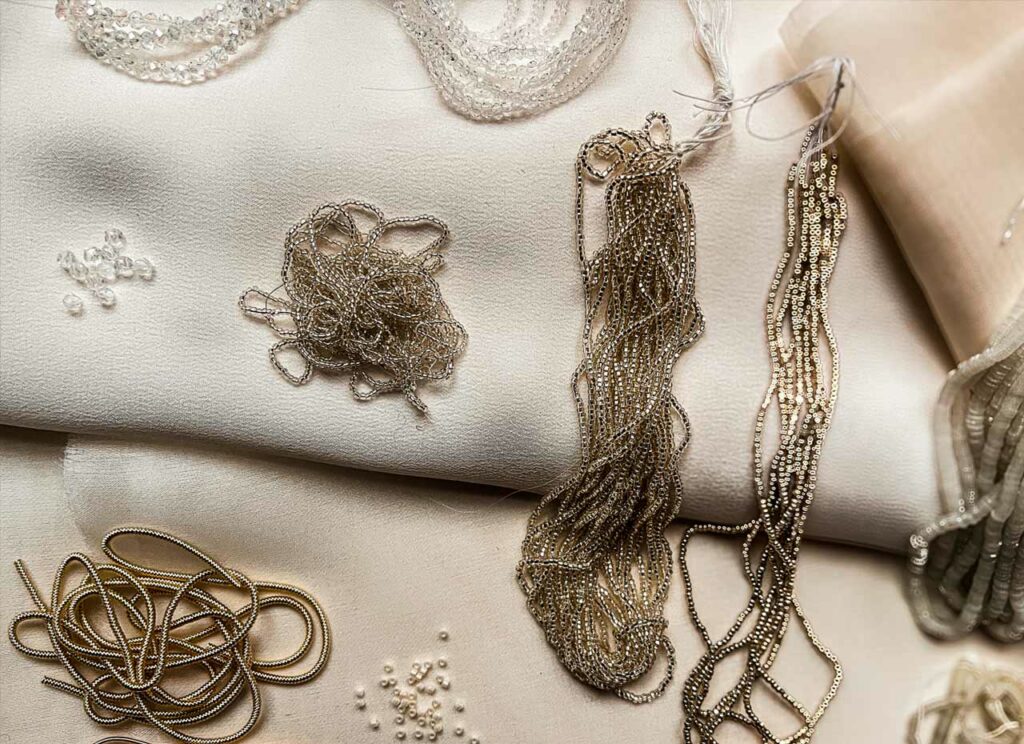
    Silk Fabrics Close-Up

    Threads — lines of intention

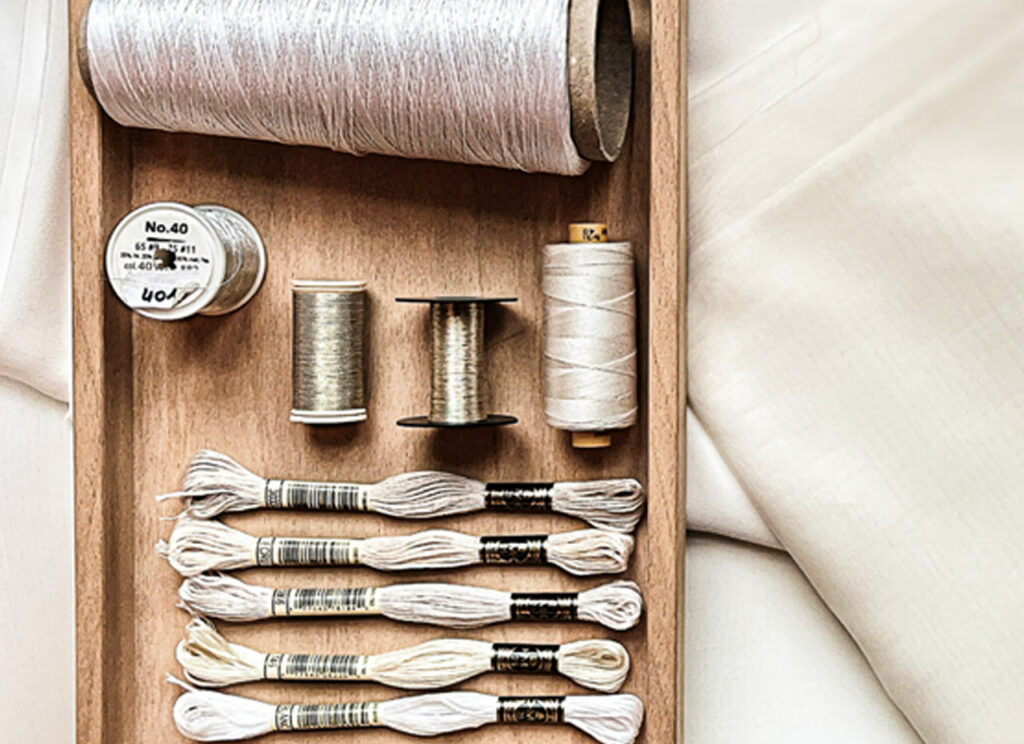
    Threads wait wound, aligned, patient.

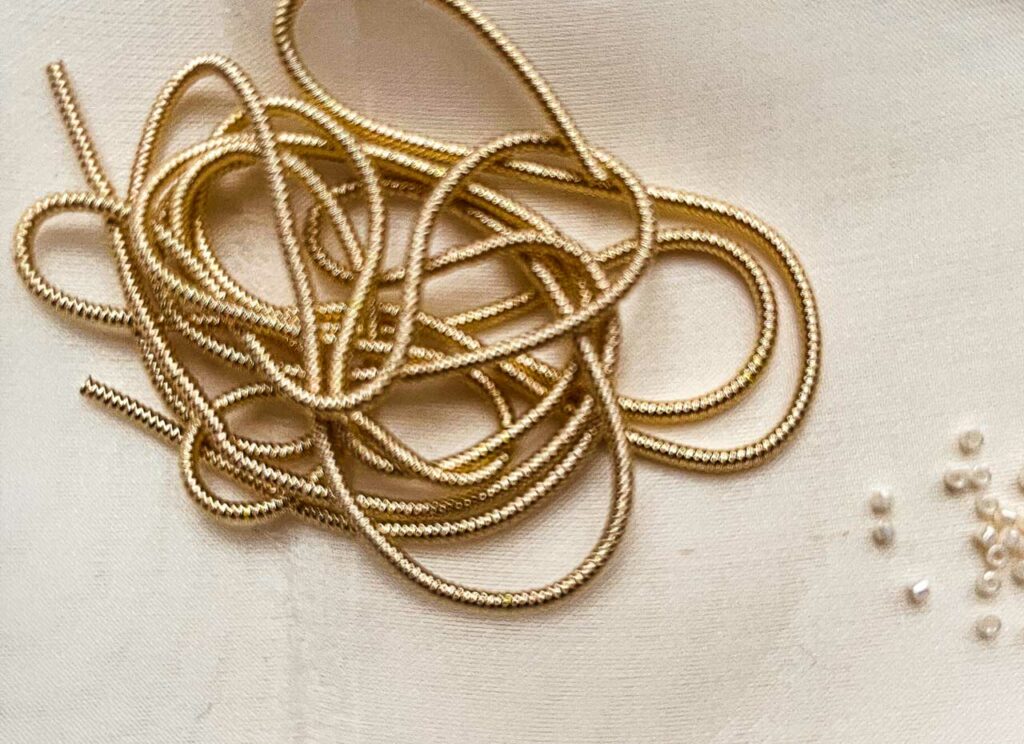
    Silk threads in softened whites glide easily through cloth. Cotton threads bring structure, anchoring delicate work. Metallic threads — silver, pale gold — remain restrained, chosen for their ability to appear only when movement calls them. Each thread is selected not for visibility, but for behavior: how it bends, how it holds tension, how it disappears once its task is done.

    Silk and metal Threads in a wooden box
    Precious Threads Close up

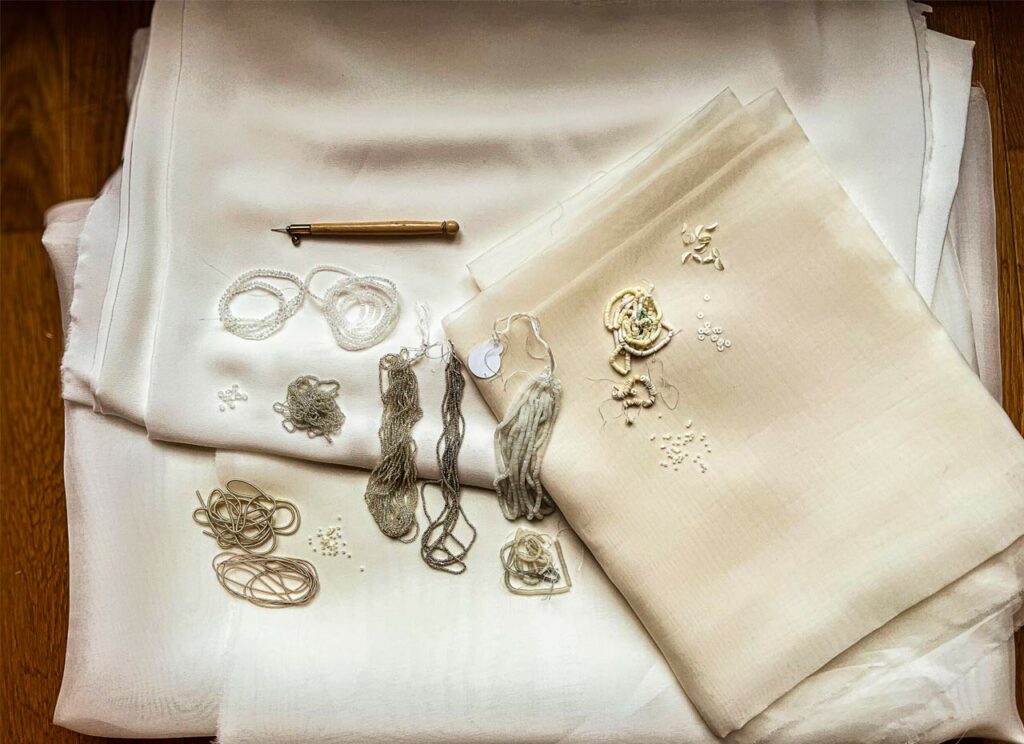
    Beads — contained lightBeads gather in small groups, sorted not only by size, but by mood.

    Beads gather in small groups, sorted not only by size, but by mood.

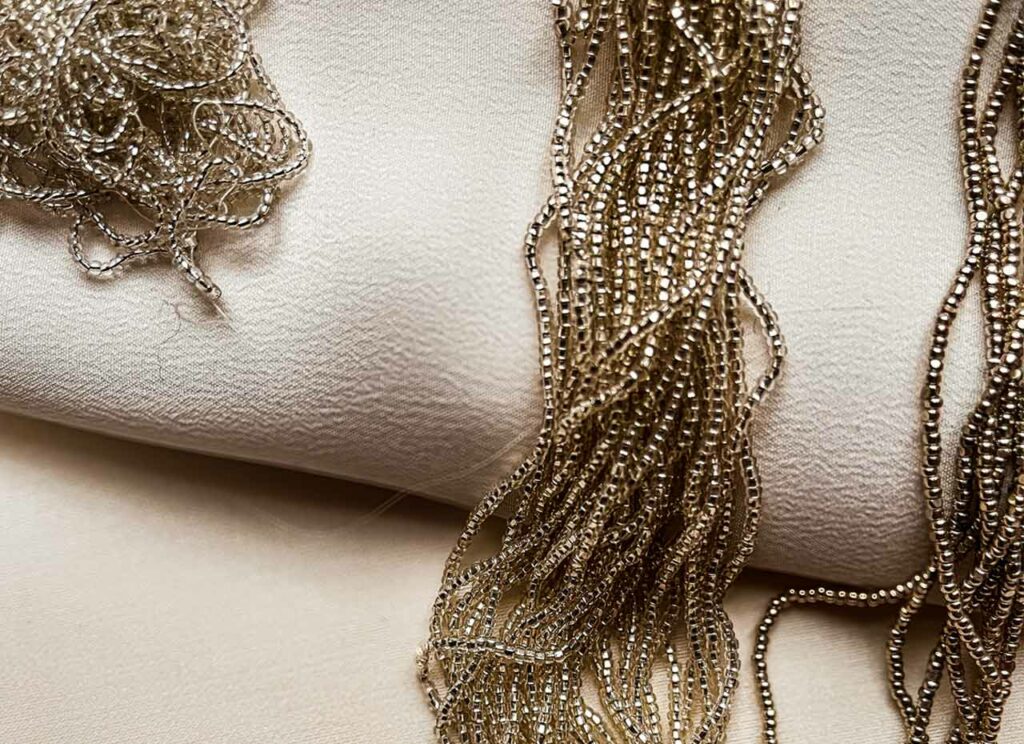
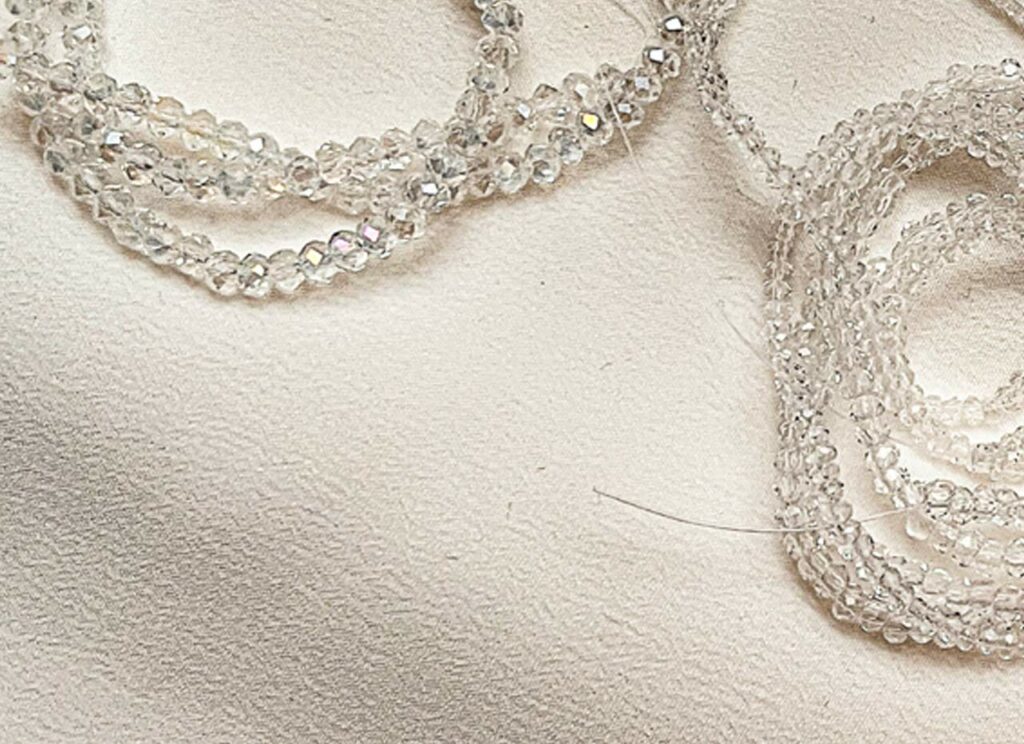
    Pearls in white and cream carry a muted glow. Seed beads in ivory offer density without weight. Champagne crystals refract warmth rather than sparkle. Silver and light gold elements punctuate, never overwhelm. In couture embroidery, beads are not scattered. They are placed. Each one holds a position — like punctuation in a sentence.

    Beads and Hook waiting for the Lunéville embroidery
    All beads on Thread for the tambour embroidery

    Threaded sequins & beads — the language of handwork

    Threaded sequins and beads rest already aligned, already fluent.

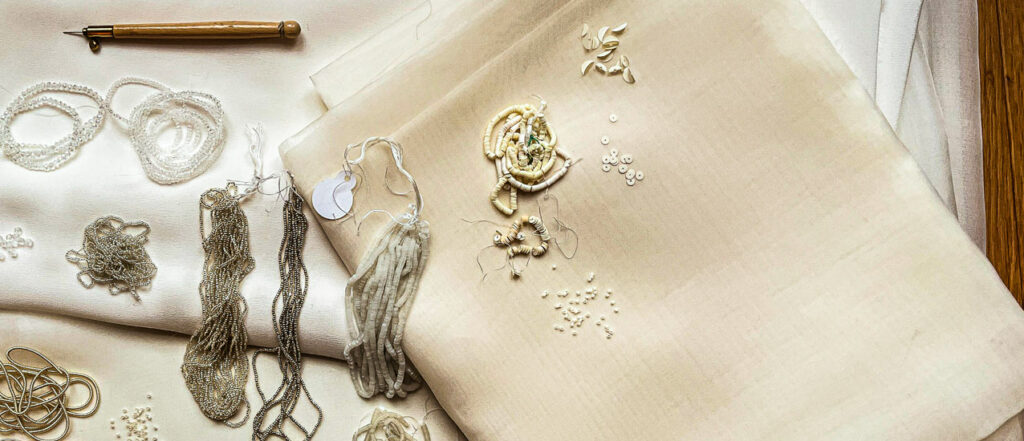
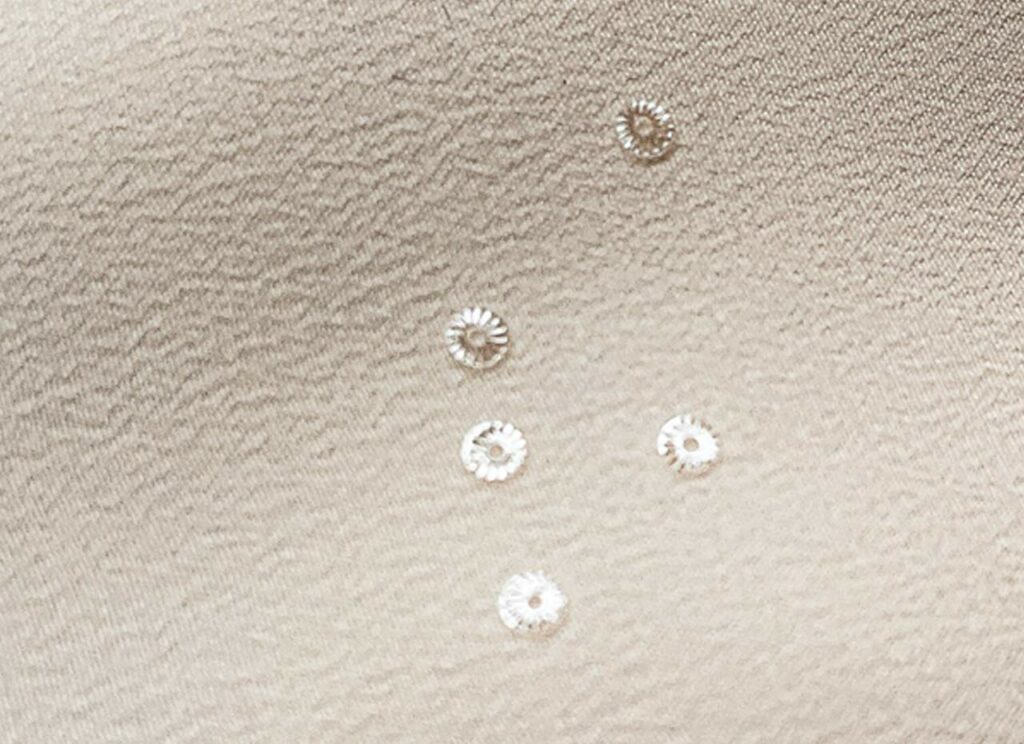
    White sequins overlap gently, suggesting petals, scales, or light caught on fabric. Ivory and champagne strands bend easily, ready to follow a curve, a motif, a movement of the hand. Silver appears briefly — a breath, not a statement.

    These elements belong to slow work. To repetition. To attention. They respond to patience more than speed, to presence more than planning.

    Paillettes on thread for the Haute-Couture embroidery

    A lineage, quietly acknowledged

    Such supplies belong to a long tradition.

    To the ateliers of haute couture embroidery. To ceremonial garments stitched for moments of passage. To opera costumes where surface tells story before a single note is sung.

    Here, the wedding dress is approached not as a trend, but as a narrative surface — a field where material, gesture, and memory meet. An object meant to hold a moment, then continue to exist beyond it.

    Cannetille or
    threaded beads

    Waiting

    Nothing is stitched yet.

    The beads remain gathered. The threads remain coiled. The fabrics remain open, receptive. They wait — not passively, but attentively — for the slow construction of a dress shaped by detail rather than excess, by intention rather than spectacle.

    A singular dress does not begin with form. It begins with materials chosen to listen.

    Cristals
    paillette soleil

    A quiet continuation

    New studies, atelier notes, and narrative surfaces quietly unfold through the journal and the studio’s letters, following their own rhythm.

    Nothing to rush.
    Only to notice.

    This journal belongs to quiet things. To surfaces shaped slowly. To gestures that leave a trace without insisting. Here, creation unfolds in fragments. A surface at a time. A detail held long enough to matter.

    For those who value restraint, handwork, and the poetry of materials, this journal offers a place to pause — and to follow the work as it reveals itself, gently, over time.

  • ( Kept in the Quiet )

    ( Kept in the Quiet )

    A nightlit inventory of forgotten companions When the light in the studio turns golden and low, something shifts. The objects begin to speak more softly — no longer tools or things with purpose, but companions in stillness. They are not always used. They are not always understood. But they are kept. This is a catalogue of what remains when the work is paused, when the hands are still and only the gaze wanders. Here are the quiet witnesses of the studio, gathered by night.

    ✦ The Box Choir

    Stacks of little containers, all meant for something else. A panettone tin that once sang of winter. A chocolate box from a place I no longer remember. Vichy pastilles. Thread. Each box carries a hush — the weight of being kept for no reason but beauty, or memory, or maybe just their soft metallic sound when opened. They sit together like members of a tiny orchestra, waiting for the next movement to begin.

    Stacks of little containers, all meant for something else. kept for no reason but beauty, or memory, or maybe just their soft metallic sound when opened.
    Vichy pastilles. A member of a tiny orchestra, waiting for the next movement to begin.

    ✦ Cabinet of Soft Spells

    A broken nutcracker from Salzburg with a grin too proud to discard. A hat pin still sharp, still waiting. A sugar stick wrapped in its own nostalgia. Paper from my grandmother, pale and untouched for years because using it would feel like forgetting. And goggles to see what can’t be seen: the Nargel (for the one who knows…), the flicker, the thing behind the thing.
    They sit together like found words from different languages, linked not by logic, but by the soft thread of having been chosen.

    A broken nutcracker, a Hat pin still sharp, a sugar stick wrapped in its own nostalgia, Paper from my grandmother, pale and untouched for years and goggles to see what can’t be seen: the Nargel, for the one who knows…
    A broken nutcracker from Salzburg, waiting to be fixed...

    ✦ Things That Wait

    One is a panda’s head — a tiny bell inside it. One is a Fatma hand, a charm of protection. One is a seashell with a perfect hole, found somewhere I forgot but kept anyway. They aren’t finished. But they’re not lost. They are meant to become necklaces. but time seems to slip. They wait like paused notes in a melody not yet played. Sometimes, unfinished things are simply dreaming.

    One is a panda’s head — a tiny bell inside it. One is a Fatma hand, a charm of protection. One is a seashell with a perfect hole.

    ✦ Decks in the Dark

    There are cards in this studio that are rarely drawn, yet never forgotten. The whisper of woods and fur (Jessica Roux’s forest deck), a curious deck — “le nouveau jeu de la main” — part game, part glimpse, the geometry of palmistry, and the Tarot de Marseille, my oldest companion,
wrapped in white and gold since I was fifteen, the way one protects a whisper. These decks hold more than answers. They hold touch. Ritual. A small theatre of symbols, shuffled in the dark, like closed doors you still know how to open.

    The whisper of woods and fur (Jessica Roux’s forest deck), a curious deck — “le nouveau jeu de la main” — part game, part glimpse, the geometry of palmistry, and the Tarot de Marseille. These decks hold more than answers. They hold touch. Ritual. A small theatre of symbols.
    Tarot de Marseille, my oldest companion,
wrapped in white and gold.

    ✦ Bottled Silences

    Tiny glass bottles — some with herbs, some with dust, some with nothing but the weight of being small and beautiful. They stand beside strange cards, matched like forgotten game pieces, no instructions, just impressions.
    And there’s the witch mirror — dark and oval, not for vanity. For reflection of another kind. It watches the room when I’m not looking. A still surface. A threshold. By daylight it’s decoration.
    By candlelight, it becomes a question.

    Tiny glass bottles

    ✦ A Ritual of Keeping

    None of these objects are useful. And yet — (NØ) keeps them.

    They hold no deadlines, no structure, no price. But they hold memory, texture, glimmers of something beyond function. They shape the studio not through action, but through presence.
    Like spells cast accidentally, like notes of a never written song, but always heard, or treasures gathered by someone you used to be.

    Tonight, (NØ) looks at them.
    Tomorrow, (NØ) might forget them again.
    But they will still be here,
    keeping the studio quietly enchanted.

    A quiet continuation

    New studies, atelier notes, and narrative surfaces quietly unfold through the journal and the studio’s letters, following their own rhythm.

    Nothing to rush.
    Only to notice.

    This journal belongs to quiet things. To surfaces shaped slowly. To gestures that leave a trace without insisting. Here, creation unfolds in fragments. A surface at a time. A detail held long enough to matter.

    For those who value restraint, handwork, and the poetry of materials, this journal offers a place to pause — and to follow the work as it reveals itself, gently, over time.

  • ( Inspiration Books )

    ( Inspiration Books )

    The day in the studio doesn’t always begin with a pencil… Often, before the first gesture, there is the slow turning of covers, the weight of a book pulled from the shelf. Certain titles stay close — not for their novelty, but for the way they hold a kind of steady presence. These are not books to rush through. They are returned to quietly, their surfaces familiar, their voices subtle. What follows is a brief glance into three such companions—books that sit near the drawing table, always within reach.

    All-Time Favorites

    Here, the three stand together—covers weathered, spines softened, pages feathered at the edges. They have been opened again and again, not out of habit, but because they continue to offer something just beneath the surface. These aren’t loud books. They don’t instruct. They linger. And somehow, each time they’re reopened, the eyes find something not seen before. They are companions, not references.

    Pattern Design by Lewis F. Day

    rigor of craft. “Pattern Design”

    Some books hold the quiet rigor of craft. “Pattern Design” is one of them. Inside, a geometry of rhythm and form—motifs that repeat, evolve, dissolve. Not decorative, but deliberate. The page feels like architecture built in pencil and ink. In the short video, the flip-through reveals the restraint and complexity of each pattern, as if each one had been thought through slowly, then let go with care. A book that teaches through watching, not explaining.

    The World of Ornament (Taschen)


    Travelling through the history and geography of pattern design

    This volume opens like a treasure trove. Each page bursts with detail—scrolls, gilded edges, flourishes that once lived in stone, on silk, in paint. Nothing here is understated. But amid the abundance, there is structure. There is lineage. “The World of Ornament” offers a way to travel visually—across centuries, various countries, materials, and methods. In motion, as the pages shift in the video, the eye moves from the smallest curl of gold to the boldest curve of marble.
    Tissus Imprimés by William Wheeler


    the trace of a woven rhythm: floral repeats, delicate overlays, saturated grounds. The Dotted Variations
    the trace of a woven rhythm: floral repeats, delicate overlays, saturated grounds. The Floral Variations

    This book breathes in fabric. Every page carries the trace of a woven rhythm: floral repeats, delicate overlays, saturated grounds. “Tissus Imprimés” is tactile even in image—its patterns suggest weight and movement, as though the cloth itself were just out of frame. In the film, the paper rustles softly, and the motifs seem to fold and unfold, like memory returning in layers. It’s not just a study of print, but of feeling.

    Which book pulls at your attention today? Open it. Let the pattern, the curve, the texture find you. More quiet glimpses from the studio coming soon—subscribe to follow the unfolding.